

You’ve built a great product and invested in an ecommerce website to sell it. You may even be posting regularly on Instagram or sending occasional email marketing promotions. Yet for some reason, the return isn’t what you hoped. Why?
Digital tools are easy to jump into, but without a plan they’re like throwing darts without a bullseye. An online marketing strategy for ecommerce gives you that bullseye. It helps you be purposeful, align your marketing with your business goals, and concentrate your resources on the best opportunities to grow sales.
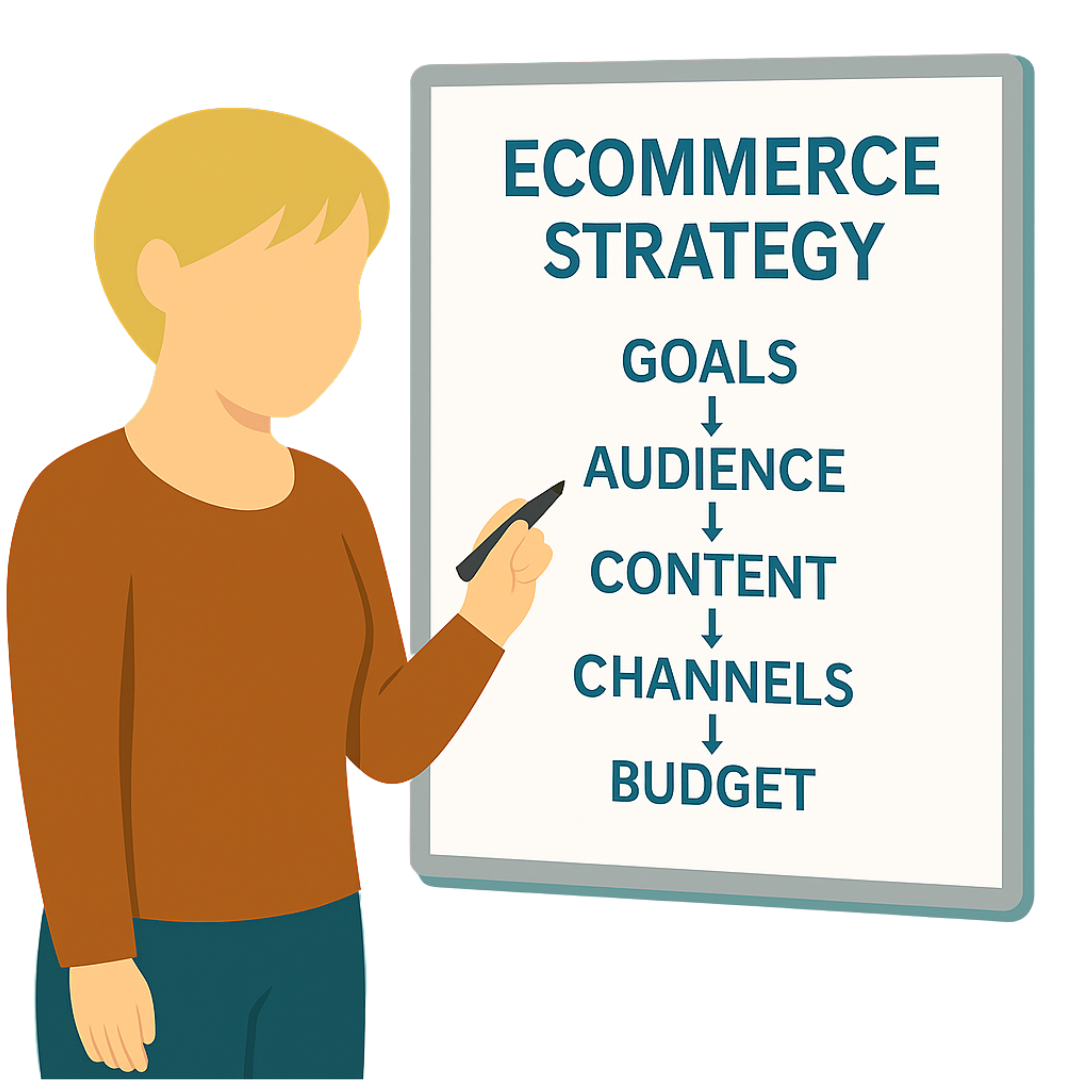
This blog will walk you through the key steps in building a strong ecommerce marketing strategy. You’ll learn how to set measurable goals, define your target customer, assess your position in the market, evaluate your assets, choose the right channels, and create a realistic budget. Along the way, we’ll highlight emerging trends—like AI personalization, short-form video, and omnichannel consistency—that can give your business an edge.
Step 1 – Align Business and Marketing Goals
Your marketing goals should always tie directly to your business objectives. For example, if your ecommerce goal is to increase revenue, your marketing goals might be to improve website traffic or capture a higher percentage of first-time buyers.
When setting goals, use the SMART method: specific, measurable, achievable, relevant, and timely. In addition, remember that your marketing strategy will only be as strong as the goals you establish. The clearer your goals, the easier it will be to measure success and adjust when needed.
Step 2 – Define Your Target Customer
You know your business, but do you know your customers? Defining your target customer is one of the most important steps in creating an online marketing strategy for ecommerce. Think about your best customers and identify what makes them ideal.
Of course, demographics such as age, gender, and location are useful. However, effective customer profiles go beyond surface details. Consider psychographics like values, lifestyle, and challenges. Use analytics tools, surveys, or customer interviews to uncover buying patterns: where they shop, when they buy, and what motivates them.
Building buyer personas helps you create content that connects. It also ensures that your ecommerce marketing speaks to real needs instead of assumptions. In fact, Shopify notes that successful ecommerce brands rely on detailed customer personas and behavior tracking to guide both product development and marketing efforts (Shopify). Increasingly, businesses are also turning to AI-powered tools for customer insights and product recommendations, which can provide a deeper layer of personalization at scale.
Step 3 – Conduct a SWOT and Competitive Analysis
Next, evaluate your place in the market. A SWOT analysis—strengths, weaknesses, opportunities, threats—gives you an honest look at your business. Pair this with competitive analysis to understand what others in your space are doing well, and where gaps exist.
For instance, if competitors are strong on Instagram but weak in email marketing, that may be an opportunity for you. As a result, this step helps you identify what sets your business apart and where to focus your marketing resources.
Step 4 – Assess Your Assets and Resources
Effective marketing requires strong content and digital assets. Take inventory of what you already have: product photos, blog posts, testimonials, social media graphics, videos, or email templates. Then ask: what can be repurposed or expanded? For example, a blog post could be turned into a video or a carousel post.
Always consider your target customer when reviewing assets. Which pieces of content will they find most valuable? This mindset ensures that every asset is not only promotional but also builds trust and connection. Short-form video, such as TikTok clips or Instagram Reels, is especially powerful right now for grabbing attention and driving ecommerce sales.
Step 5 – Choose the Right Channels and Tools
With your goals, audience, and assets in place, it’s time to choose where to market. Not every channel is right for every business. Instead, focus on the ones that connect you with your ideal buyers.
For example, if your customers are women under 65, Instagram and TikTok may be strong options. If your audience is older, Facebook might deliver better results. If you’re selling a B2B productivity tool, LinkedIn could be your most effective channel.
Think beyond social media as well. Email marketing, blogging, SEO, paid ads, affiliate partnerships, and influencer collaborations can all play a role in your strategy. The goal is not to be everywhere, but to be in the right places with consistent, engaging content. In fact, Omnisend reports that multichannel strategies can increase purchase rates by up to 287% compared to single-channel campaigns (Omnisend). And wherever you show up, work toward an omnichannel experience, so customers feel a seamless connection whether they’re browsing your site, scrolling social feeds, or opening an email.
Step 6 – Plan Your Budget
Marketing takes investment. Some tools are free or low-cost, but to reach your goals you’ll likely need to budget for ads, content creation, or software. Your budget doesn’t have to be large, but it should be realistic. In addition, it should be aligned with your goals so you can measure the return on every dollar spent.
Don’t forget retention in your budget planning. Loyalty programs, referral incentives, and automated email sequences are cost-effective ways to keep your best customers engaged and coming back.
Online Marketing Strategy – Final Thoughts
With these six steps, you can create an online marketing strategy for ecommerce that guides your efforts with clarity and purpose. You’ll know who you’re trying to reach, where to find them, and how to engage them with meaningful content.
However, strategy and execution aren’t the same. Once your strategy is in place, you’ll need a plan for implementation, measurement, and refinement. Modern ecommerce is dynamic, so think of your strategy as a living document that evolves with customer behavior, technology, and market shifts.
Ready to Build Your Online Marketing Strategy?
Creating an effective strategy is one thing. Putting it into action is another. That’s where I can help. From content creation and SEO to email marketing, website maintenance, and social campaigns, I work with businesses like yours to turn strategy into results. If you’re ready to grow your ecommerce brand with a plan that works, let’s connect. I offer freelance content marketing in Raleigh and beyond, helping you reach the right customers with clarity and purpose.